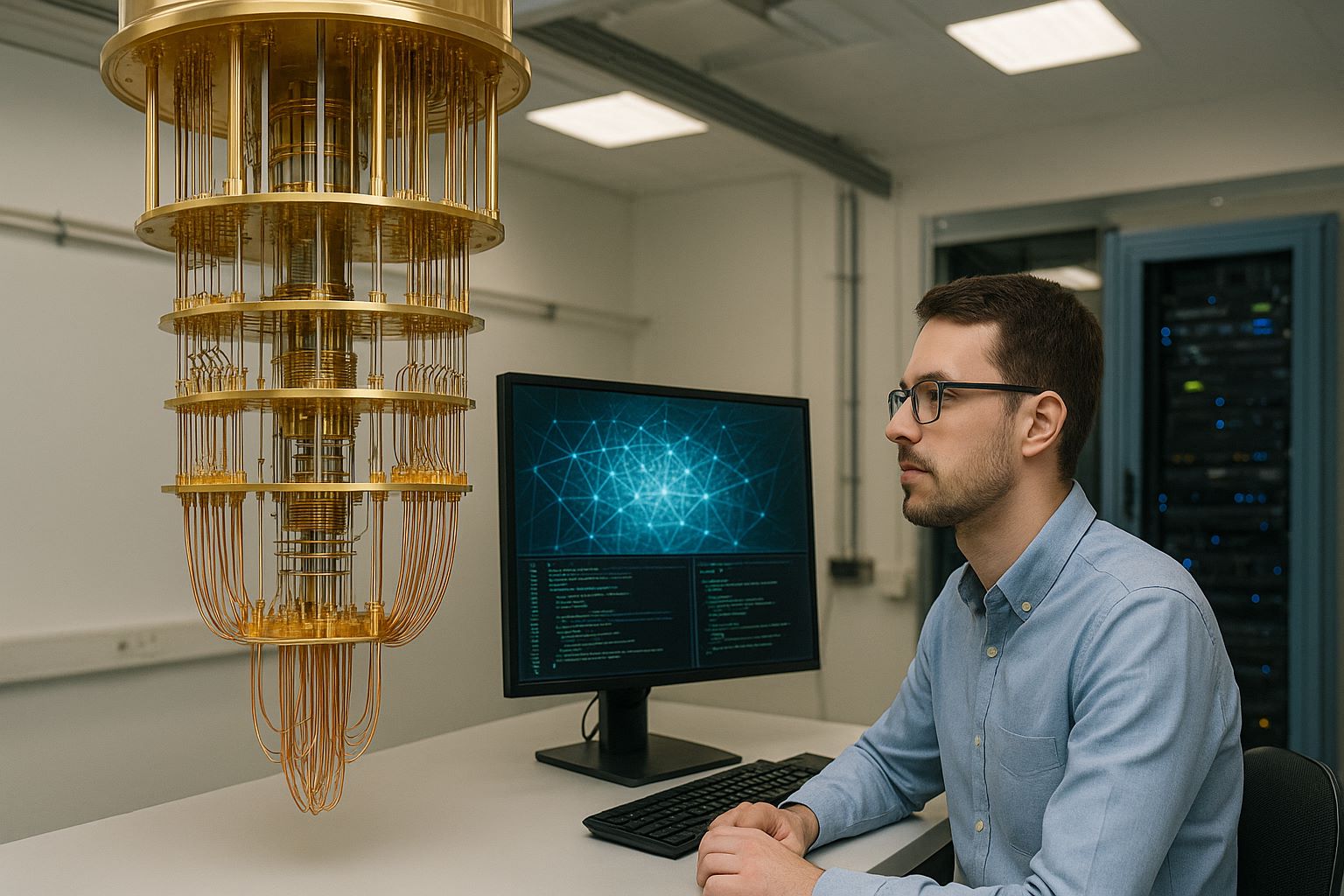
Technology has always evolved in leaps — from the invention of the steam engine to the rise of the internet, and now to the next major revolution: Quantum Computing.
Thank you for reading this post, don't forget to subscribe!While traditional computers have powered our digital world for decades, their limitations are becoming clear as data grows exponentially and problems become more complex. Quantum computing, on the other hand, promises to redefine the boundaries of computation, offering processing power that could solve problems previously thought impossible.
From drug discovery and cybersecurity to artificial intelligence and climate modeling, quantum computing stands at the forefront of technological innovation and transformation.
In this article, we’ll explore what quantum computing is, how it works, its potential applications, challenges, and why it’s considered the next big leap in technology.
1. What Is Quantum Computing?
To understand quantum computing, let’s first compare it to the computers we use today.
Traditional computers — also known as classical computers — process information in bits, which can be either 0 or 1. Every calculation, app, or website operates using these binary bits.
Quantum computers, however, use quantum bits or qubits, which can exist as 0, 1, or both at the same time (a state known as superposition). This allows them to perform multiple calculations simultaneously, drastically increasing their computational power.
In simple terms:
- A classical computer tries every possible solution one by one.
- A quantum computer can try many possibilities at once, thanks to quantum physics.
This massive parallelism gives quantum computers the potential to solve problems in seconds that would take classical computers millions of years.
2. How Quantum Computing Works
Quantum computing is based on principles from quantum mechanics, the branch of physics that deals with the behavior of particles at atomic and subatomic levels.
Here are the key concepts behind it:
a. Qubits
Qubits are the building blocks of quantum computing. Unlike bits, they can represent multiple states at once (0, 1, or both). This property is what gives quantum computers their unique power.
b. Superposition
Superposition allows qubits to process multiple possibilities simultaneously, enabling quantum computers to explore numerous outcomes in parallel.
c. Entanglement
When qubits become entangled, the state of one qubit instantly influences the state of another, no matter how far apart they are. This allows for faster and more efficient computation and communication.
d. Quantum Interference
Quantum computers use interference to amplify correct results and cancel out incorrect ones, ensuring accurate computations.
Together, these phenomena make quantum computers capable of performing complex, multidimensional calculations beyond the reach of classical machines.
3. Quantum Computing vs. Classical Computing
| Feature | Classical Computing | Quantum Computing |
| Basic Unit | Bit (0 or 1) | Qubit (0, 1, or both) |
| Processing Power | Sequential | Parallel |
| Speed | Limited by transistor count | Exponential increase with qubit count |
| Error Correction | Simple | Complex (due to quantum noise) |
| Best For | Everyday computing, business apps | Complex simulations, cryptography, optimization |
Quantum computing isn’t meant to replace classical computers — it’s designed to complement them by tackling problems traditional systems can’t handle.
4. The Major Players in Quantum Computing
Several global tech giants and research institutions are racing to make quantum computing practical and commercially viable.
a. IBM
IBM introduced the IBM Quantum Experience, allowing developers to experiment with real quantum processors through the cloud. Its IBM Quantum System One is among the most advanced public quantum computers.
b. Google
In 2019, Google AI announced achieving quantum supremacy, claiming its 53-qubit quantum processor “Sycamore” performed a task in 200 seconds that would take a supercomputer 10,000 years.
c. Microsoft
Microsoft’s Azure Quantum platform integrates multiple quantum technologies, offering developers easy access through cloud computing.
d. Intel
Intel focuses on developing scalable quantum chips and exploring materials that can improve qubit stability and reduce errors.
e. Startups and Research Labs
Companies like Rigetti Computing, IonQ, and D-Wave are pioneering innovative approaches using superconducting circuits, trapped ions, and quantum annealing.
The global race for quantum dominance is intensifying, with governments investing billions in national quantum initiatives.
5. Real-World Applications of Quantum Computing
While still in its early stages, quantum computing is already showing promise across various industries:
a. Drug Discovery and Healthcare
Quantum computers can simulate molecular interactions at an atomic level, drastically speeding up the development of new drugs.
Pharmaceutical companies can use quantum simulations to identify effective compounds, reducing years of research into months.
Example: Quantum models are being explored to design new cancer drugs and antiviral treatments.
b. Cryptography and Cybersecurity
Quantum computing poses both a threat and an opportunity for cybersecurity.
While it could break existing encryption systems, it also enables quantum encryption methods that are virtually unbreakable.
Quantum Key Distribution (QKD) ensures ultra-secure communication channels resistant to hacking.
c. Artificial Intelligence and Machine Learning
AI and quantum computing are a powerful combination.
Quantum algorithms can analyze vast datasets faster, enhancing pattern recognition, optimization, and prediction accuracy.
For instance, quantum-enhanced AI could revolutionize climate modeling, financial forecasting, and natural language processing.
d. Financial Modeling
Banks and investment firms use quantum computing to simulate complex financial systems, manage risk, and optimize portfolios in real time.
It can evaluate thousands of potential market scenarios simultaneously, offering a competitive edge in decision-making.
e. Logistics and Supply Chain Optimization
Quantum computers can solve optimization problems — such as finding the fastest delivery routes or minimizing costs — far more efficiently than classical systems.
Companies like DHL and Volkswagen have already begun experimenting with quantum-powered logistics solutions.
f. Climate Science and Energy
Quantum simulations help model complex natural systems — like atmospheric patterns, energy storage, and carbon capture — providing insights that could help fight climate change.
They’re also being used to develop new materials for batteries and solar panels, paving the way for a greener future.
6. The Benefits of Quantum Computing
Quantum computing brings immense advantages that can redefine the technological landscape:
- Unparalleled Speed: Quantum processors can handle calculations exponentially faster.
- Enhanced Problem-Solving: Solves problems too complex for classical computers.
- Innovation Acceleration: Speeds up research and development in fields like medicine, AI, and materials science.
- Improved Security: Enables advanced encryption for safer digital communications.
- Data Efficiency: Processes large datasets in less time with fewer resources.
7. The Challenges and Limitations
Despite its promise, quantum computing faces significant hurdles before it becomes mainstream:
a. Qubit Stability
Qubits are extremely sensitive to temperature, radiation, and interference, leading to quantum decoherence, which causes computational errors.
b. Error Correction
Unlike traditional bits, qubits require advanced error-correction mechanisms to maintain accuracy — a major engineering challenge.
c. High Costs
Quantum computers require ultra-cold environments and advanced hardware, making them extremely expensive to build and maintain.
d. Software and Algorithm Development
Quantum programming is complex and still evolving. Developers must learn quantum languages like Q#, Qiskit, or Cirq.
e. Ethical and Security Concerns
The power of quantum computing could disrupt data privacy, encryption, and global cybersecurity frameworks if misused.
8. The Future of Quantum Computing
Quantum computing is still in its infancy, but experts predict rapid progress over the next decade.
By the 2030s, we may see commercially viable quantum systems solving real-world problems at scale.
Emerging Trends:
- Quantum Cloud Services: Accessing quantum computers via cloud platforms (e.g., IBM Quantum, Azure Quantum).
- Hybrid Computing: Combining classical and quantum systems for optimal performance.
- Quantum Internet: A new era of secure, instantaneous global communication.
- AI-Driven Quantum Control: Using AI to stabilize qubits and reduce noise.
Governments worldwide — from the U.S. and China to the EU and Japan — are investing billions in quantum research, ensuring they don’t fall behind in this transformative race.
9. Preparing for the Quantum Era
Businesses and individuals must begin preparing for the quantum revolution today.
For Businesses:
- Invest in quantum research partnerships.
- Train IT and engineering teams in quantum programming.
- Explore hybrid models integrating quantum and classical systems.
For Professionals:
- Learn about quantum algorithms, data science, and AI integration.
- Focus on problem-solving, mathematics, and physics fundamentals.
Those who adapt early will have a significant competitive advantage in tomorrow’s digital economy.
10. Conclusion
Quantum computing represents the next giant leap in human innovation. It holds the potential to unlock new scientific discoveries, revolutionize industries, and solve problems that have long challenged human understanding.
While still developing, the progress made so far proves that this technology isn’t just theoretical — it’s becoming a practical reality.
As we enter the quantum age, one thing is clear: the companies, scientists, and nations that master quantum computing will shape the future of technology, science, and global progress.
The quantum revolution has begun — and it’s set to change the world forever.