Introduction: The Expanding World of Digital Money
Cryptocurrency has evolved far beyond its original purpose as a digital payment system. What began with Bitcoin in 2009 has now expanded into a vast ecosystem of thousands of digital currencies, each designed with unique goals, technologies, and use cases. Today, cryptocurrencies are no longer limited to online transactions — they power smart contracts, decentralized finance (DeFi), NFTs, and global remittances, revolutionizing how we think about money and trust.
Thank you for reading this post, don't forget to subscribe!In 2025 and beyond, understanding the different types of cryptocurrencies is crucial for anyone interested in digital finance — whether you’re an investor, trader, or everyday user. From the pioneering Bitcoin to the stable and predictable stablecoins, every category of crypto plays a vital role in shaping the future of the decentralized economy.
This article breaks down the main types of cryptocurrencies, explaining how each works, what makes them unique, and how they contribute to the global blockchain ecosystem.
1. Bitcoin: The Original Cryptocurrency
1.1 What Is Bitcoin?
Bitcoin, created by the mysterious Satoshi Nakamoto in 2009, is the first and most recognized cryptocurrency in the world. It introduced the idea of a peer-to-peer digital cash system, allowing users to send money anywhere without banks or intermediaries.
Bitcoin operates on a decentralized network of computers called nodes, which verify transactions using a process known as mining — a part of the Proof of Work (PoW) consensus mechanism. Each transaction is recorded on a transparent, immutable ledger called the blockchain.
1.2 Why Bitcoin Still Leads
Even after thousands of alternatives emerged, Bitcoin remains the gold standard of cryptocurrencies. It’s often referred to as “digital gold” because of its limited supply of 21 million coins, which protects it from inflation. Many investors view Bitcoin as a store of value rather than just a medium of exchange.
Institutions, companies, and even governments are beginning to adopt Bitcoin as part of their reserves, solidifying its role as the foundation of the cryptocurrency world.
2. Altcoins: The Diverse Alternatives to Bitcoin
2.1 What Are Altcoins?
“Altcoin” simply means any cryptocurrency other than Bitcoin. These coins were developed to improve upon Bitcoin’s design or introduce new features. Some aim for faster transactions, while others focus on privacy, scalability, or smart contract functionality.
Altcoins represent innovation within the crypto industry — each bringing something new to the table.
2.2 Examples of Major Altcoins
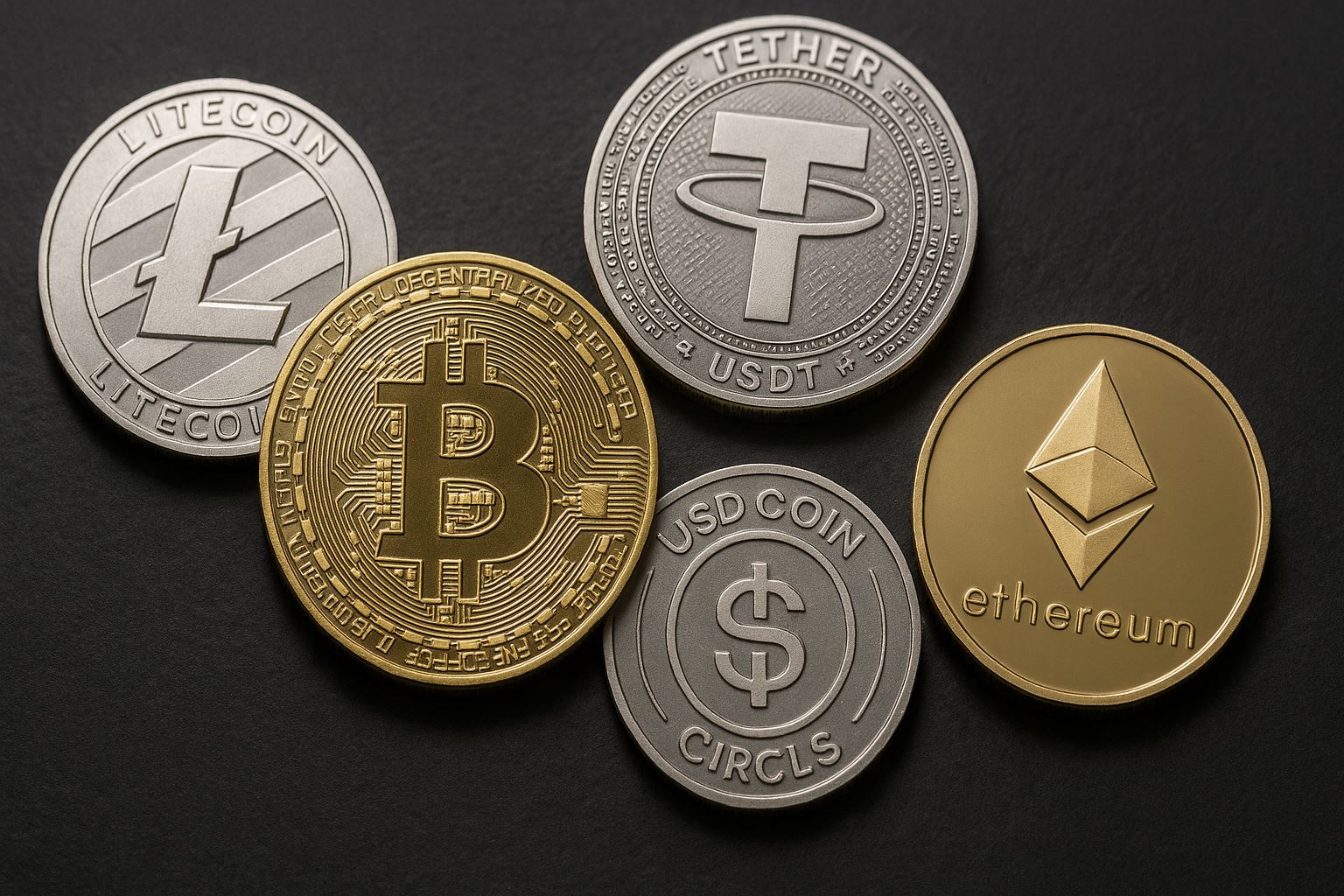
- Ethereum (ETH): The first blockchain to introduce smart contracts, allowing developers to build decentralized applications (dApps). It’s the backbone of DeFi and NFT ecosystems.
- Cardano (ADA): Known for its energy-efficient Proof of Stake (PoS) mechanism and focus on academic research.
- Solana (SOL): Recognized for its lightning-fast transaction speeds and scalability, ideal for dApps and Web3 projects.
- Polkadot (DOT): Focuses on interoperability, connecting different blockchains into a unified ecosystem.
- Litecoin (LTC): Created as a “lighter” version of Bitcoin, it offers faster confirmation times and lower fees.
2.3 Why Altcoins Matter
Altcoins push blockchain innovation forward. They explore new consensus mechanisms, governance models, and applications that Bitcoin doesn’t offer. For investors, altcoins also represent opportunities for higher growth — though they often carry higher volatility.
3. Stablecoins: The Bridge Between Crypto and Traditional Finance
3.1 What Are Stablecoins?
One of the biggest challenges in cryptocurrency is price volatility. Stablecoins were created to solve this. A stablecoin is a digital currency pegged to a stable asset, such as the U.S. dollar, euro, or even gold.
This peg keeps their value relatively constant, making them ideal for trading, remittances, and payments.
3.2 Types of Stablecoins
- Fiat-Collateralized Stablecoins: Backed by real-world currency reserves.
Example: Tether (USDT), USD Coin (USDC), and TrueUSD (TUSD). - Crypto-Collateralized Stablecoins: Backed by other cryptocurrencies stored in smart contracts.
Example: DAI from the MakerDAO protocol. - Algorithmic Stablecoins: Maintain stability through automated algorithms that expand or contract supply based on demand.
Example: Ampleforth (AMPL) and FRAX.
3.3 Why Stablecoins Are Important
Stablecoins are the link between traditional and decentralized finance. They enable smooth trading between volatile cryptocurrencies, allow users to earn interest in DeFi platforms, and are increasingly used for cross-border transactions at a fraction of the cost of traditional methods.
4. Utility Tokens: The Power Behind Blockchain Ecosystems
4.1 What Are Utility Tokens?
Utility tokens are cryptocurrencies designed to access specific products or services within a blockchain ecosystem. They are not intended as investments but as a means of participation in a network.
4.2 Examples of Utility Tokens
- BNB (Binance Coin): Used to pay trading fees and participate in token sales on Binance.
- Chainlink (LINK): Powers decentralized oracle networks that bring real-world data into smart contracts.
- Uniswap (UNI): Enables governance and liquidity operations on the Uniswap decentralized exchange (DEX).
4.3 Role of Utility Tokens
Utility tokens help fuel blockchain ecosystems, ensuring that users and developers can interact seamlessly. They are crucial to maintaining decentralization and incentivizing participation in DeFi and Web3 platforms.
5. Governance Tokens: Power to the Community
5.1 Understanding Governance Tokens
Governance tokens give holders voting rights in decentralized organizations (DAOs) or blockchain protocols. This allows users to propose and vote on key decisions — from software updates to fee structures.
5.2 Popular Governance Tokens
- Aave (AAVE): Used to decide how the Aave DeFi lending platform evolves.
- Maker (MKR): Allows holders to vote on changes to the DAI stablecoin system.
- Compound (COMP): Gives users control over interest rate models and liquidity pools.
5.3 Why Governance Tokens Matter
They represent the democratization of finance — allowing communities, not corporations, to shape the direction of decentralized platforms. Governance tokens are a vital part of blockchain’s push toward true decentralization.
6. Privacy Coins: Protecting Financial Anonymity
6.1 The Rise of Privacy Coins
While most cryptocurrencies are transparent, privacy coins focus on enhancing user anonymity. They hide transaction details like sender, receiver, and amount to ensure financial privacy.
6.2 Examples of Privacy Coins
- Monero (XMR): Uses advanced cryptography to conceal transaction data.
- Zcash (ZEC): Offers optional privacy through “shielded transactions.”
- Dash (DASH): Provides fast, semi-anonymous payments.
6.3 The Privacy Debate
While privacy coins are valued for protecting individual rights, they also face scrutiny from regulators concerned about illegal activity. Balancing privacy and compliance will be key to their future.
7. Meme Coins and Community Tokens: The Fun Side of Crypto
7.1 What Are Meme Coins?
Born from internet culture, meme coins started as jokes but gained massive popularity. Coins like Dogecoin (DOGE) and Shiba Inu (SHIB) have large communities and strong social media presence.
7.2 Why They Matter
Although speculative, meme coins highlight the power of community in driving value. They’ve introduced millions to cryptocurrency and often serve as entry points for new investors.
8. The Future of Cryptocurrency Diversity
The crypto industry is expanding rapidly, with new categories emerging every year — from asset-backed tokens to CBDCs (Central Bank Digital Currencies). This diversity is driving innovation across global finance, enabling faster payments, programmable money, and decentralized economies.
As the market matures, expect more integration between traditional finance and blockchain, making digital currencies a permanent fixture of everyday life.
Conclusion: A Universe Beyond Bitcoin
Cryptocurrency is no longer defined by Bitcoin alone. It has evolved into a multifaceted ecosystem where every type of digital currency serves a unique purpose — whether it’s Bitcoin as a store of value, Ethereum powering decentralized apps, or stablecoins ensuring price stability.
Understanding these categories helps investors make smarter decisions and appreciate the broader vision of blockchain technology: a transparent, decentralized, and inclusive financial future.
The more you explore, the clearer it becomes — cryptocurrencies aren’t just the future of money; they’re the future of the global economy itself.